


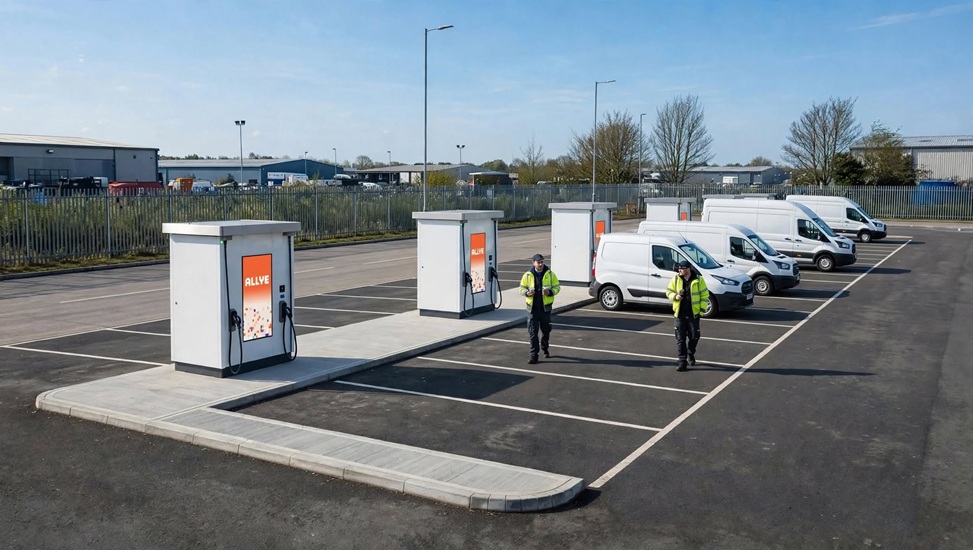
Allye Energy Launches 400kW Battery-Buffered EV Charger
Allye Energy Launches Groundbreaking 400kW Battery-Buffered EV Charger to Overcome Grid Constraints
New MEV range combines repurposed EV batteries, ultra-rapid DC charging and 800V architecture to accelerate fleet electrification without costly grid upgrades.
- Up to 400kW ultra-rapid charging: Power two vehicles simultaneously using battery-buffered DC technology, even with limited grid capacity.
- Fast, flexible deployment: Start charging within hours of installation using an existing three-phase or even single-phase electricity supply.
- Available from £70,000: Two launch models, MEV200 and MEV300, with charging-as-a-service options starting at £1,900 per month.
London, 27 October 2026 – UK clean-tech innovator Allye Energy has unveiled the Allye MEV (MAX for EV), a pioneering battery-buffered EV charging system designed to tackle one of the biggest barriers to fleet electrification: limited grid capacity.
Combining ultra-rapid DC charging with integrated battery energy storage made from whole repurposed electric vehicle battery packs, MEV can deliver up to 400kW of charging power to two vehicles simultaneously, even when connected to a limited 16A electricity supply.
Unlike conventional EV chargers that depend on substantial grid connections, MEV stores energy from the existing electricity supply and releases it when vehicles need rapid charging. This helps businesses accelerate fleet electrification without waiting years for expensive grid upgrades.
Engineered and manufactured in the UK, using batteries from UK-registered vehicles and 95% British-sourced components, MEV represents a significant step forward in sustainable EV charging infrastructure.
Starting at £70,000, the range comprises two models, MEV200 and MEV300, with deliveries expected from Q2 2027. The launch also positions Allye to support businesses preparing for Round 2 of the UK Government’s Depot Charging Scheme.
Tackling the UK’s EV Charging Infrastructure Challenge
Grid capacity has become one of the biggest obstacles to the widespread adoption of electric commercial vehicles.
At this year’s Fleet Electrification Forum, 47% of delegates identified grid capacity as a major barrier to fleet electrification. Meanwhile, securing a new depot electricity connection can take between 18 and 36 months, according to freight infrastructure body TwentyForty.
The UK Government has also highlighted connection delays of up to 15 years in some cases, with the connection queue having grown tenfold in five years.
For businesses operating electric fleets, these delays can significantly affect investment decisions, operating costs and electrification targets.
However, many depots already have access to sufficient energy throughout the day. The challenge is delivering that energy at the speed required when multiple vehicles need charging.
Allye MEV addresses this challenge by storing electricity when demand is lower and delivering high-power DC charging when vehicles need it most.
The technology builds on Allye’s experience delivering battery-buffered charging solutions through its MAX energy storage systems.
During the pre-phase of the Government’s Depot Charging Scheme, Allye and its partner Chargepoly deployed a battery-buffered charging solution at J&M Murdoch’s refuse depot in Glasgow, where a grid upgrade had been quoted at £300,000.
Within a single day, a MAX300 system was buffering the site’s existing 32A (22kW) electricity supply. It now supports a satellite DC fast charger serving two electric vehicles and delivering approximately 200kWh of energy daily.
MEV takes this proven approach further by introducing a dedicated battery-buffered EV charging solution.
How the Allye MEV Battery-Buffered Charging System Works
The MEV range launches with two models, designed to meet different commercial charging requirements:
- MEV200: 155kWh of integrated energy storage.
- MEV300: 232kWh of integrated energy storage.
Both models use whole repurposed EV battery packs, helping reduce the environmental impact associated with manufacturing new battery cells.
According to Allye’s estimates, reusing these battery packs avoids approximately 15 to 24 tonnes of CO2e emissions per MEV unit compared with using new cells.
At the heart of the system is Allye’s proprietary PackFlex technology, which enables individual battery packs to operate with independent battery management and power control. This allows battery packs of different sizes, ages and chemistries to work together within a single cabinet.
The system’s 800V architecture is designed to maximise efficiency and charging performance while supporting both 400V and 800V electric vehicles.
MEV is also designed for future expansion, allowing businesses to increase storage capacity and charging power on site with minimal disruption and without additional groundworks.
Plug-and-Play EV Charging Without Waiting for Grid Upgrades
One of MEV’s biggest advantages is its ability to simplify the installation of high-power EV charging infrastructure.
Businesses can begin charging vehicles within a few hours of delivery, using existing industrial electrical sockets or a hard-wired connection.
Allye manages the complete installation process, from initial site surveys through to commissioning. The system is also designed to fit within permitted development requirements.
Unlike permanent charging infrastructure that can become difficult or expensive to relocate, MEV can be removed and reinstalled at another location if a depot moves or a business lease expires.
This flexibility makes it particularly attractive for fleet operators, logistics businesses, local authorities and commercial organisations looking to expand their EV charging capacity without committing to major infrastructure projects.
Robert Carter, Chief Technology Officer at Allye Energy, said:
“MEV is the direct result of our work on the MAX300. The hard part was never the battery. It was making packs of different sizes and ages behave as one system and deliver up to 400kW of DC charging through an 800V architecture and our in-house technology stack. Once we had solved that, MEV was the obvious next step: the same architecture in a cabinet that only ever charges, where one pack can slide out for service while the others keep charging.”
Smarter, Safer and More Reliable EV Charging Infrastructure
MEV has been designed with driver safety, charger protection and operational reliability in mind.
A 2024 AA and Electrifying.com survey of 11,565 drivers found that 55% of women identified personal safety concerns at charging points as a reason not to switch to an electric vehicle.
To address these concerns, MEV incorporates intelligent lighting designed to activate when a driver approaches. The system illuminates connectors and the surrounding ground using shielded, low-glare lighting.
Cameras provide coverage of charging bays and cables, with recording activated on approach.
The system also incorporates cable protection technology to help reduce downtime caused by theft and vandalism.
Each MEV charging cable includes cut detection, forensic marking and quick-release terminals to support faster replacement.
Battery safety is addressed through individual pack protection, including pyro fuses to isolate high-voltage circuits, off-gas detection and fire barriers between battery packs. Fire suppression is also available as an option for critical installations.
For charge point operators (CPOs), MEV offers additional operational and commercial features.
Smart lighting provides a visible indication of charger status, while optional AI-powered bay monitoring can identify vehicles blocking charging bays or overstaying their permitted charging time.
At busy public charging locations, the integrated 65-inch front display can generate additional advertising revenue between charging sessions. Optional 65-inch side displays provide further opportunities for digital advertising and site communication.
The screens feature low-glare technology, remote updates and flexible operating controls.
MEV and MAX300: Two Complementary Energy Solutions
Allye’s MEV and MAX product ranges are designed for different applications but share the same underlying technology.
MEV is designed for fixed EV charging locations, enabling depots and fleet operators to deliver high-power charging using their existing electricity supply.
MAX300 is designed for flexible energy deployment, providing mobile and stationary energy storage for sites requiring temporary or additional power.
Built on the same proven architecture, MAX300 can power sites, replace diesel generators and deliver EV charging at up to 400kW through integrated DC fast charging or by supplying satellite chargers.
Mounted on its integrated trailer, MAX300 weighs under 3.5 tonnes and can be towed by a van or pick-up under a standard Category B driving licence.
The MAX300 starts at £78,000 as an energy storage system, rising to £99,000 for the stationary configuration with integrated DC fast charging.
Together, the two ranges provide businesses with flexible energy storage and EV charging solutions for a wide variety of applications.
Reducing the Total Cost of EV Charging
Although battery-buffered EV chargers can involve a higher initial investment than conventional charging equipment, they can deliver significant savings over their operational lifetime.
By drawing power from a smaller grid connection, MEV can help businesses avoid the additional capacity charges associated with upgrading their electricity supply.
For example, an additional 200kVA connection can cost approximately £8,900 annually under National Grid Electricity Distribution’s 2026/27 South West tariff.
MEV can also recharge its batteries overnight when electricity rates are lower, then deliver stored energy during weekday evening peak periods, when network charges can be more than 100 times higher.
Through the MAX range’s integrated energy management software, businesses can also access wholesale energy trading through a virtual lead party and participate in grid services, enabled by electricity market rule change P415.
Based on Allye’s calculations, an MEV200 is designed to recover its additional investment compared with a conventional 200kW charger within two to three years.
Over ten years, the system is projected to deliver savings of £50,000 to £110,000, excluding any additional savings from avoiding a grid upgrade.
These benefits make battery-buffered charging an increasingly attractive option for businesses seeking to reduce the long-term costs of commercial EV charging infrastructure.
EV Charging as a Service: Flexible Financing for Businesses
To make high-power EV charging more accessible, Allye is also offering MEV through its EV Charging as a Service (EVCaaS) model.
Starting at £1,900 per month for an MEV200, the fully inclusive subscription model removes the need for a large upfront capital investment.
Instead of funding expensive charging infrastructure as a capital project, fleet operators, depots and local authorities can access charging capacity through a predictable monthly operating cost.
The model also allows businesses to expand their charging infrastructure as their electric fleets grow, without having to invest in additional grid capacity years in advance.
Jonathan Carrier, Founder and CEO of Allye Energy, said:
“We have built two ranges, not two versions of the same thing. If the charger stays put and only ever charges vehicles, MEV does it on the supply you already have, often for less than the connection works it replaces. If the energy needs to move, towed behind a van or feeding a row of chargers, that is the MAX300. But better products are only half the answer. To deploy charging at the pace the transition needs, we have to make it far cheaper, and that takes innovation in the business model and the supply chain as well as the product. Charging as a service, a monthly fee instead of a capital bill, is how fleets, depots and local authorities get more charging for less.”
Proven Battery Storage Technology Already in Operation
MEV builds on Allye’s established experience in commercial battery energy storage.
More than 20 MAX systems, incorporating over 100 repurposed batteries, are already operating with customers including JLR and Roadchef. According to Allye, 60% of its customers have returned for additional systems.
At Roadchef’s Killington Lake motorway services on the M6, a MAX300 has been operating for more than two years using a fixed 315A electricity supply shared between shops, a hotel and EV charging infrastructure.
During its first year, the system prevented 12 site trips, each of which could have resulted in power interruptions lasting up to four hours. It also generated estimated savings of approximately £120,000 without requiring a grid upgrade.
The need for flexible energy infrastructure is particularly evident across the UK’s motorway network. According to the National Audit Office, only around 10% of England’s 114 motorway service areas have the electricity capacity required to meet projected EV charging demand.
Allye’s MAX technology is also supporting major infrastructure projects.
At the Lower Thames Crossing, National Highways’ most ambitious infrastructure scheme in 35 years and one of the world’s largest zero-emission construction sites, MAX500 units are providing charging for electric excavators.
The systems have delivered more than 900 charging sessions and over 126MWh of energy.
This operational experience provides the foundation for Allye’s next step in dedicated, battery-buffered EV charging infrastructure.
Allye Energy Seeks International Distribution Partners
As demand for flexible EV charging and battery energy storage solutions continues to grow, Allye Energy is appointing distribution partners for its MEV range across the UK and international markets.
The company is particularly interested in working with:
- EV charging infrastructure installers.
- Charge point operators (CPOs).
- Fleet energy management specialists.
- Regional and international technology distributors.
Partners will be able to supply, install and support MEV systems within their respective markets, offering customers both outright purchasing and charging-as-a-service options.
Interested organisations can contact sales@allye.com to discuss distribution opportunities.
Allye MEV: High-power EV charging, without waiting for the grid.
For more information about Allye Energy and its battery energy storage and EV charging solutions, visit Allye Energy’s website.




Industry Sector

Archives
Our Clients